
Cow Manure Just Became Jet Fuel: Inside the World-First Breakthrough That Could Reshape Aviation
For the first time ever, a jet can fly on fuel made from cow manure. A California startup just turned raw dairy biogas into certified aviation fuel at one-fifth the cost of European plants. Here's the full story of the breakthrough that could reshape flying, farming, and the fight against climate change.
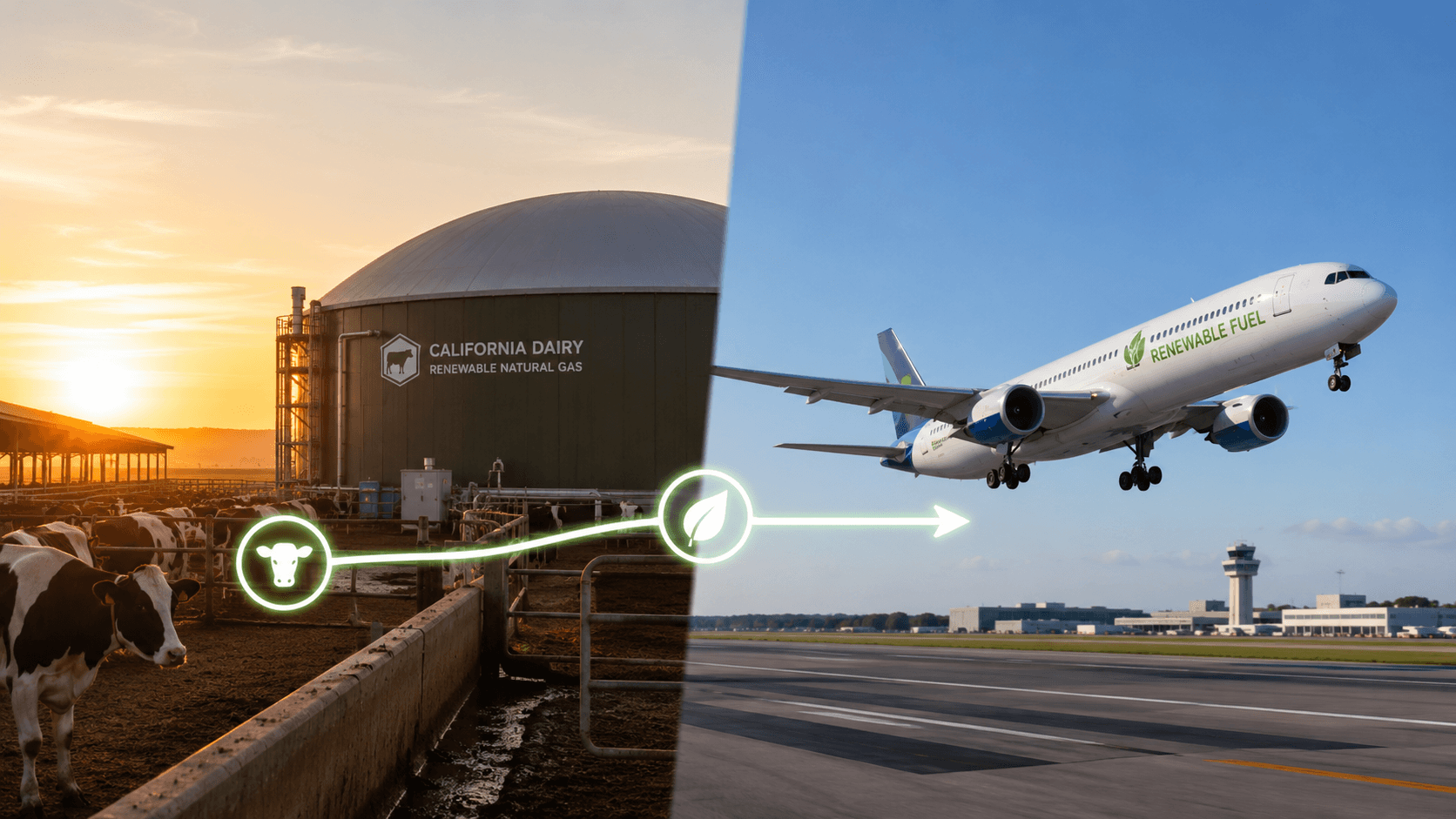
For the first time in history, an aircraft can fly on fuel made from cow manure.
In June 2026, a California startup called Circularity Fuels announced it had completed the world's first end-to-end conversion of raw dairy farm biogas into certified jet fuel. Not in a lab. Not as a chemistry-class proof of concept. But continuously, for six months, using actual waste gas pumped straight from the manure digesters of a working dairy farm.
The fuel met the strict international standard required to power commercial aircraft. And the economics — long the fatal weakness of clean aviation fuel — finally appear to work.
This isn't an incremental improvement. It's a potential turning point for one of the hardest industries on Earth to decarbonize. Here's the full story, what makes it remarkable, and why it matters for farmers, airlines, the climate, and possibly the price of your next plane ticket.
What Actually Happened
A renewable fuels company based in Redwood City, California, ran a six-month pilot project at a dairy farm near Madera, in the heart of California's Central Valley. The farm is home to more than 5,000 cattle — and like most dairy operations, it produces enormous quantities of manure.
That manure doesn't just sit there. It's pumped into sealed tanks called manure digesters, where bacteria break it down into two things: a nutrient-rich solid called digestate (useful as fertilizer) and a methane-heavy gas known as biogas.
On most farms, that biogas is a problem. It's either burned off — a process called flaring — or simply vented straight into the atmosphere. Both are wasteful. One is actively harmful, because methane is a vastly more potent greenhouse gas than carbon dioxide over the short term.
Circularity's pilot did something no one had done at this scale before: it took that raw biogas, exactly as it came out of the digester, and converted it directly into finished aviation fuel on-site. Over thousands of operating hours, the system ran on raw biogas that was roughly 65 percent methane and 35 percent carbon dioxide, drawn straight from the dairy's digester, and produced drop-in jet fuel.
Why "World First" Is Not an Exaggeration
People have made sustainable aviation fuel before. People have captured biogas before. So what makes this a genuine first?
The answer is the phrase "end-to-end" and the word "raw."
Previous approaches required the biogas to be cleaned and upgraded first — an expensive, infrastructure-heavy process. The high concentration of carbon dioxide in raw agricultural methane has historically been the single biggest barrier to economical conversion, because removing it required millions of dollars in specialized cleaning hardware and, usually, a commercial gas pipeline nearby to make the whole thing viable.
Circularity skipped all of that. Its system takes the raw, dirty, CO₂-heavy gas directly and turns it into certified jet fuel in one integrated process. As one industry veteran who develops agricultural biogas projects put it, Circularity is the first team he's seen take raw biogas straight from a digester and turn it into finished jet fuel on-site — something that changes the entire conversation for dairy operators.
The Technology, Explained Simply
The system is built around two compact, skid-mounted reactors — meaning they're modular and small enough to be installed directly on a farm, rather than requiring a massive centralized refinery.
Step one: The Ouro reactor. This is an electrified bi-reforming reactor. Its job is to take the raw biogas and convert it into something called synthesis gas (or "syngas") — a key chemical building block. The impressive part: it does this in a single electrified step, and it handles the carbon dioxide rather than requiring it to be stripped out first. During testing, this reactor achieved methane conversion rates above 98 percent and carbon dioxide conversion rates exceeding 90 percent.
Step two: The Aion reactor. This is a compact Fischer-Tropsch synthesis reactor. The Fischer-Tropsch process is a century-old, well-understood chemistry that converts syngas into liquid hydrocarbons. In this case, those hydrocarbons are refined into liquid fuel suitable for aircraft.
Because both reactors are modular and skid-mounted, the entire system is sized for the small, distributed scale at which biogas is actually produced. You don't need to truck the gas to a central plant. You bring the plant to the gas.
It Passed the Test That Actually Matters: ASTM D7566
Making a flammable liquid from cow waste is one thing. Making one that an airline will actually pour into a jet engine is another entirely.
The fuel Circularity produced met the ASTM D7566 Annex A1 standard. That is the international specification a synthetic fuel must meet to be certified safe for commercial aviation. In plain terms, it confirms the fuel won't damage jet engines.
Crucially, this certification means the fuel is a "drop-in" replacement. It can be blended up to 50 percent with conventional Jet-A fuel and used in today's commercial aircraft, with no engine modifications required. Airlines don't have to wait for new planes or new infrastructure. The fuel works in the fleet that's already flying.
The Real Breakthrough Is the Price
Here's where this story shifts from "cool science experiment" to "potential industry disruptor."
Clean aviation fuel has always existed in some form. The problem has never been whether it could be made — it's whether it could be made cheaply enough to compete with cheap fossil jet fuel. Most clean fuel projects fail this test badly.
Circularity claims its farm-scale technology can produce sustainable aviation fuel at an installed capacity capital cost of under $100,000 per barrel-per-day. According to the company, that's roughly one-fifth the capital cost of comparable SAF plants currently under construction in Europe.
That cost reduction is the entire ballgame. It's what allows the company to claim its biogas-derived fuel can compete directly with fossil jet fuel pricing — even from a first-of-its-kind commercial plant. As the company's founder put it, the hard part of this industry was never designing a theoretical plant that could make clean fuel. It was proving you could do it continuously, from real biogas, at a cost that actually adds up.
The Climate Math Is Genuinely Stunning
Most "green" fuels reduce emissions. This one, on paper, goes further — it's described as carbon-negative.
Circularity's internal life-cycle analysis suggests the fuel achieves a carbon intensity score of negative 350.7 grams of CO₂ equivalent per megajoule under California's regulatory framework. A negative number means the fuel's production removes more greenhouse gas from the atmosphere than burning it puts back.
How is that possible? The benefit comes from capturing methane that would otherwise have escaped into the atmosphere. Methane traps dramatically more heat than carbon dioxide over shorter timescales, so preventing its release delivers an outsized climate benefit. The company calculates that every gallon produced removes roughly 100 pounds of CO₂ equivalent from the air.
Whether that exact figure holds up under independent scrutiny at commercial scale remains to be seen — internal life-cycle analyses are not the same as verified third-party audits. But even a fraction of that number would represent a meaningful climate win.
Who Wins: A New Revenue Stream for Farmers
One of the most overlooked angles here is what this means for dairy farmers.
Today, biogas is mostly a liability. Farmers either vent it or flare it, getting nothing in return while taking on the environmental cost. The pilot host farm near Madera currently vents nearly all of its biogas to the atmosphere — despite sitting in the heart of America's largest dairy region.
Circularity's model flips that. It lets farmers monetize methane on-site, without the cost of removing carbon dioxide first. A waste product becomes a sellable commodity. For an industry running on thin margins, a new revenue stream from something they were previously throwing away could be transformative.
This is the "circular economy" idea in its purest form: one industry's waste becomes another industry's fuel.
Why Aviation Needs This So Badly
Aviation is one of the hardest sectors to decarbonize. You can't run a long-haul jet on batteries — they're far too heavy for the energy they store. That leaves liquid fuel as the only realistic option for the foreseeable future, which makes sustainable aviation fuel the industry's primary climate lever.
The problem is supply. Current global SAF production satisfies less than one percent of total aviation fuel demand. That leaves an enormous gap between what airlines are mandated to use under tightening international sustainability rules and what actually exists.
Most SAF made today relies on used cooking oil as its feedstock. That source has a hard ceiling: there's only so much used cooking oil in the world, and much of it is imported, which raises both scalability and energy-security concerns. Other approaches, like power-to-liquid "e-fuels," struggle economically as electricity costs rise.
Agricultural biogas sidesteps these limits. It's one of the lowest-cost feedstocks available precisely because almost all of it currently goes to waste. And the scale is vast — by the company's estimate, the world's waste biogas resource is large enough, in theory, to supply the entire global jet fuel market.
The Money and the People Behind It
Circularity Fuels emerged from the DCVC incubator program and is backed by $8 million in seed funding, along with awards from ARPA-E, the National Science Foundation, and the California Energy Commission.
The company was founded by Dr. Stephen Beaton, who previously served as Lab Chief of the United States Air Force Petroleum Office — giving him deep, direct experience with the chemistry and logistics of aviation fuel. That background matters. This isn't a team of outsiders guessing at jet fuel; it's led by someone who ran fuel science for the Air Force.
There's also a smart business angle baked into the model. Because the fuel is derived from biogas, it qualifies for federal and state biofuel incentives — including the EPA's Renewable Fuel Standard and California's carbon-negative Low Carbon Fuel Standard pathway. Those are the same incentive programs that allowed renewable natural gas, ethanol, and biodiesel to scale up commercially. They give SAF from biogas a proven financial runway to reach commercial volumes.
What Happens Next
The pilot is complete and the technology stack is validated in the field. The next step is commercial deployment.
Circularity Fuels expects to break ground on its first commercial-scale facility in 2027. The company is actively evaluating expansion sites across major dairy and agricultural regions in the United States, Latin America, and Europe.
If those commercial plants deliver on the cost and performance promises shown in the pilot, the implications ripple outward fast: cheaper clean fuel for airlines under pressure to decarbonize, new income for farmers, reduced methane emissions, and a scalable feedstock that doesn't depend on imports or limited supplies of used cooking oil.
The Honest Caveats
It's worth keeping a level head. A successful six-month pilot is a major milestone, but it is not the same as a proven commercial industry. A few things to watch:
The carbon-negative figure comes from the company's own internal life-cycle analysis and will need independent verification at scale. Pilot economics don't always survive the jump to full commercial operation, where real-world variables tend to multiply. And much of the financial case currently leans on government subsidies — which, while well-established, are subject to political change.
None of this diminishes the achievement. It simply means the right posture is cautious optimism, not a victory lap. The science worked. The economics looked promising. The real test comes in 2027 and beyond.
The Bottom Line
For decades, the dream of clean aviation has run into the same wall: it was always too expensive, too small-scale, or too dependent on limited feedstocks to matter.
Turning cow manure into certified jet fuel — continuously, on-site, at a cost that can compete with fossil fuel — chips away at all three problems at once. It takes a potent greenhouse gas that was being wasted, turns it into fuel an airline can use today, pays a farmer for the privilege, and may pull carbon out of the air in the process.
If it scales, it won't just be a clever piece of chemistry. It'll be one of the more elegant climate solutions of the decade — the kind that makes money for everyone involved while quietly cleaning up two dirty industries at the same time.
The age of flying on cow power may have just begun.
What do you think — is biogas the future of clean flight, or is this another green tech promise that won't survive commercial scale? Let us know in the comments.