
How long does a Hajj take?
The core rituals of Hajj run five or six days, but almost nobody is actually away from home for that short a stretch. Here's what the real timeline looks like, from Mina to the flight home.
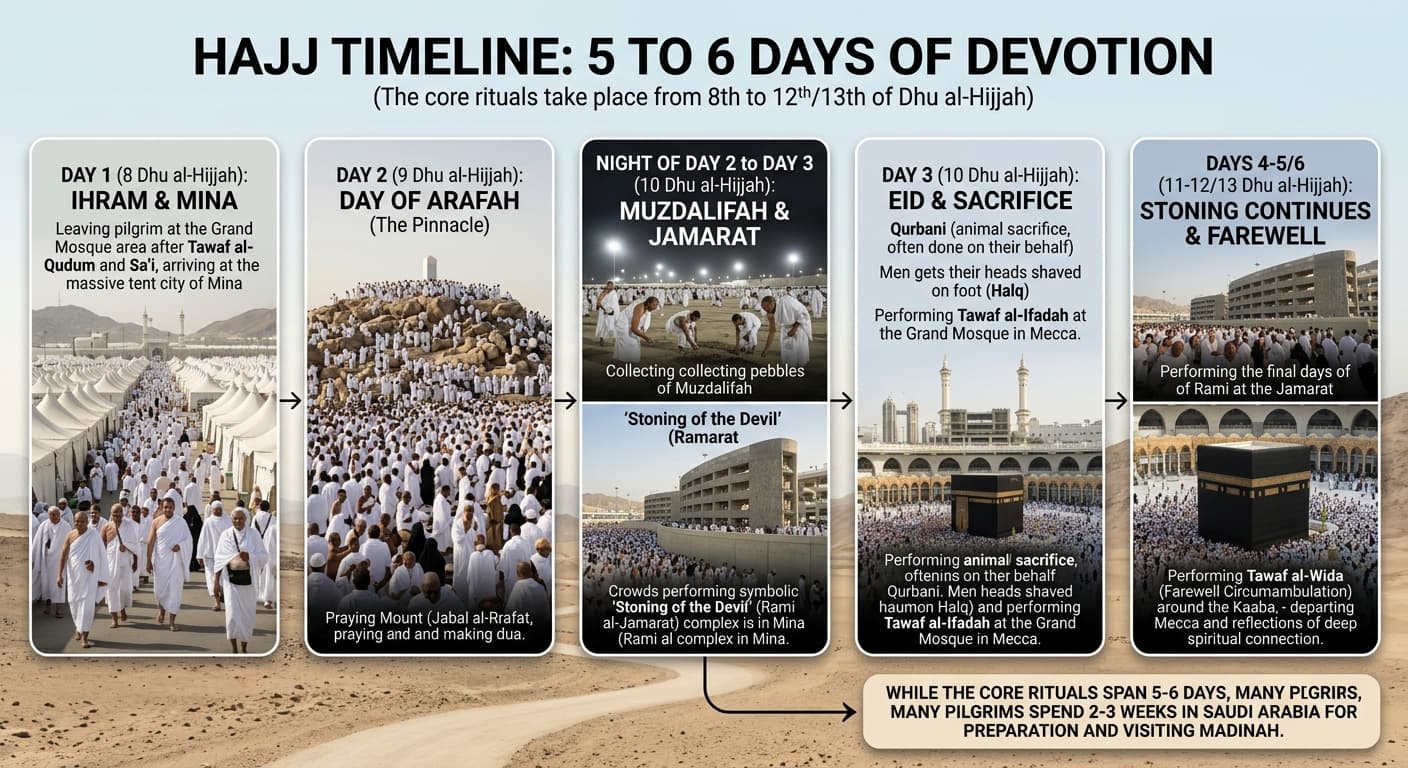
The short answer, and why it's misleading
The rituals of Hajj take five or six days, depending on how you count the start. That's the number most guides give you, and it's correct as far as it goes. But if you ask how long does a Hajj take in terms of what actually shows up on your calendar, flights included, the honest answer is closer to two to four weeks.
That gap between the ritual count and the real-world count trips up a lot of first-time pilgrims. They plan time off work for six days, maybe a week with margin, and then discover their tour operator has them in Saudi Arabia for eighteen.
How long does a Hajj take, day by day?
Hajj runs on the Islamic lunar calendar, from the 8th to the 12th or 13th of Dhul Hijjah. Each day has a fixed location and a fixed task. Skip ahead or compress them and the ritual isn't valid, which is part of why the sequence can't realistically be rushed.
Day (Dhul Hijjah) | Location | What happens |
|---|---|---|
8th | Mina | Pilgrims arrive and stay overnight, reciting talbiyah and praying the five daily prayers shortened |
9th | Arafat | The core of Hajj: standing at Arafat from noon until sunset. Miss this and the Hajj is void |
9th night | Muzdalifah | Travel after sunset, collect pebbles, sleep under open sky |
10th | Mina | Stone the largest Jamarat, sacrifice an animal, shave or trim hair, then Tawaf al-Ifadah in Mecca |
11th-12th | Mina | Stone all three Jamarat each afternoon, known as the days of tashreeq |
13th (optional) | Mina | A final day of stoning for those who didn't leave early on the 12th |
Lay those six days out and you get the figure most sites quote when someone asks how long does a Hajj take. It's accurate for the religious obligation itself. It just isn't the figure that matters when you're booking flights.
The part that adds the extra two weeks
Almost nobody flies into Jeddah on the 7th of Dhul Hijjah and flies home on the 13th. Visa rules, flight availability, and group logistics stretch things further. Most package operators from the UK, US, and South Asia run itineraries of 14 to 21 days, with several extra days built in on either side for Mecca and Medina.
Saudi Hajj visas themselves are typically issued for a window of several weeks, not five or six days, precisely because the ministry expects pilgrims to arrive early and leave late. Airport congestion around the Hajj season is severe enough that flying in two or three days before the 8th is standard practice, not an indulgence.
Why your actual trip is longer than the rituals suggest
Three things routinely stretch a Hajj trip well past the six-day core, and they're worth planning around rather than discovering mid-trip.
Umrah before or after. Many pilgrims combine Hajj with an Umrah, performed either before the 8th or after the stoning ends, adding two to four days of its own rituals in Mecca.
A Medina visit. Not obligatory, but included in most packages. Visiting the Prophet's Mosque typically adds three to five days, usually tacked on after Mina rather than before.
Group travel logistics. Large tour groups move as a block. If your bus to Muzdalifah waits two hours for stragglers, that's two hours you didn't choose and can't skip.
Put those together and a pilgrim answering how many days is Hajj for them personally, door to door, is usually looking at somewhere between 15 and 25 days away from home.
Does arriving late or leaving early actually work?
Here's a case worth knowing. Pilgrims who miss standing at Arafat on the 9th before sunset have missed Hajj for that year, full stop; there's no makeup day. This is the single non-negotiable point in the entire Hajj pilgrimage schedule, and it's why tour operators build in so much slack around the 9th specifically.
On the other end, early departure from Mina is allowed under what's called Nafr al-Awwal: leaving on the 12th before sunset, after completing that day's stoning, rather than staying for the 13th. It trims one day off the trip and plenty of pilgrims use it, particularly those with tighter flight windows or health concerns about the crowds.
What actually happens once the rituals end
The stoning finishes, the ihram restrictions lift, and then there's usually a gap of several days before the flight home. Some of that is logistics: Jeddah and Medina airports process hundreds of thousands of departing pilgrims over a narrow window, and flights get staggered accordingly.
Some of it is intentional. Many pilgrims use the final days for a farewell Tawaf, for shopping, or simply to rest after five physically demanding days in extreme heat. That tail end of the trip matters more than people expect, and it's worth reading up on what to do when returning from Hajj before you're in the middle of it, since the adjustment back to ordinary routine catches a lot of pilgrims off guard.
A quick note on the calendar itself
Because Dhul Hijjah follows the lunar year, the Gregorian dates for Hajj move back roughly 11 days every year. A pilgrim asking how long does a Hajj take in 2025 versus 2035 gets the same answer in ritual days, five to six, but the actual calendar dates look completely different a decade apart. Worth knowing if you're trying to plan leave from work years in advance.
None of this changes the core fact. The obligation itself is short. What swallows the month is everything Saudi Arabia, your airline, and your own itinerary wrap around it.
Frequently asked questions
Can you shorten Hajj by skipping Mina on the 11th or 12th?
No. Staying in Mina through the days of tashreeq and stoning all three Jamarat is part of the ritual sequence, not an optional extension. Some scholars allow an early departure on the 12th (Nafr al-Awwal) before sunset, which trims one day, but that's the only legitimate shortcut and it still requires completing that day's stoning first.
Does the length of Hajj change every year?
The rituals themselves always run the same five to six days of the Islamic calendar. What changes is where those days fall on the Gregorian calendar, since Dhul Hijjah shifts about 11 days earlier each year under the lunar system.
Is it cheaper to book a shorter Hajj package?
Sometimes, but a 10-day package usually just means less buffer time around Mecca and Medina, not fewer ritual days. Tour operators build in flexibility for flight delays and Saudi logistics, and the shortest packages are the ones most likely to feel rushed if anything goes wrong.
Do you need to visit Medina as part of Hajj?
No. Visiting the Prophet's Mosque in Medina is not a requirement of Hajj itself, which is why some pilgrims skip it entirely. Most package operators include it anyway, usually adding three to five days before or after the core rituals.
How soon can you fly home after Hajj ends?
Technically, as soon as your visa and flight allow, often the same evening the stoning at Mina concludes. In practice most pilgrims stay a few extra days to rest, shop, or complete a final Tawaf before departure.