

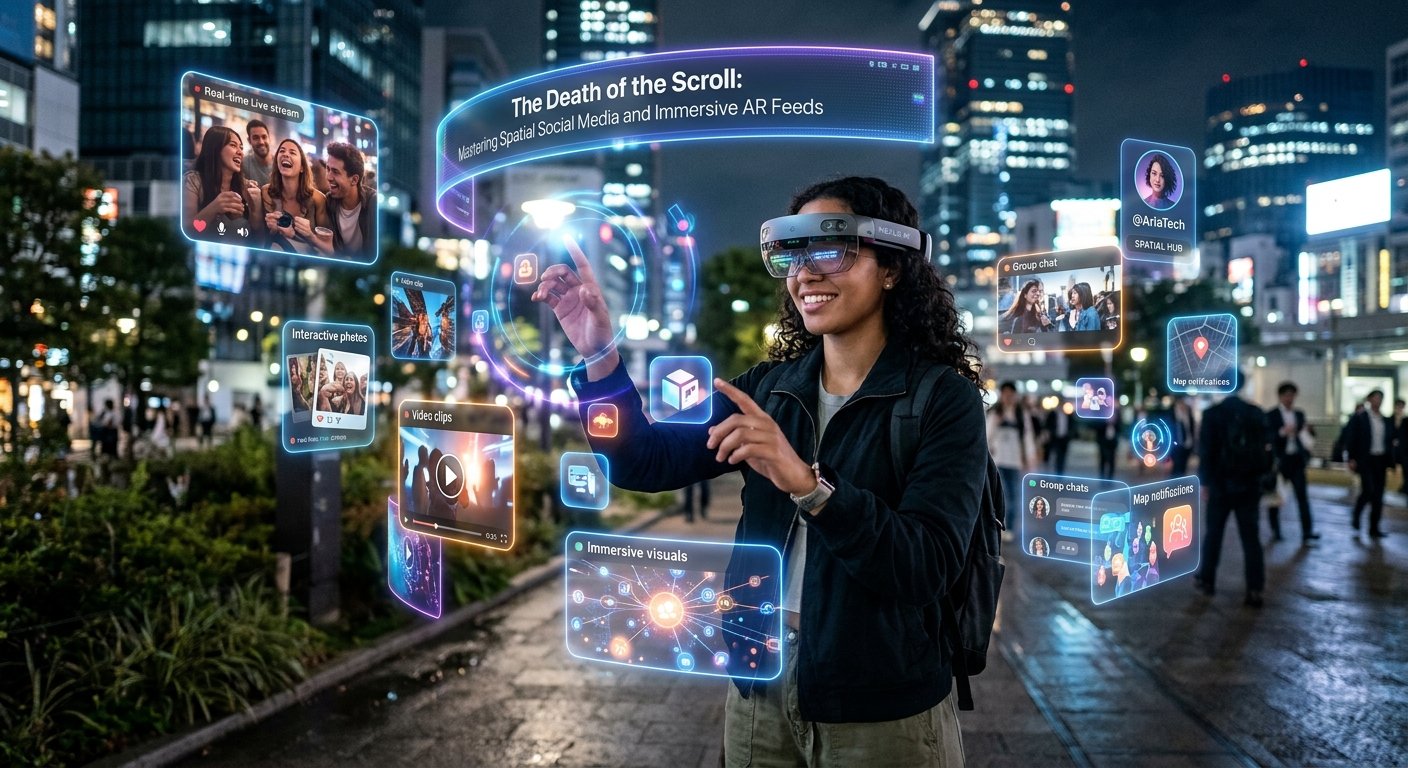
The Era of the 2D Feed is Flatlining
Let’s be honest: We’re all tired. Tired of the endless, zombie-like thumb-swipe. Tired of the algorithmic sameness. Tired of consuming content that feels increasingly disconnected from our physical reality.
For over a decade, the scroll has been the defining interaction of the internet. It was a revolutionary way to consume information quickly. But like all things in tech, it’s evolving. Actually, it’s doing more than that. It’s dying.
We are standing on the precipice of a paradigm shift: the death of the scroll and the birth of spatial social media. The future isn’t a flat feed you consume; it’s an immersive reality you inhabit.
What is Spatial Social Media?
If you’re a child of the 90s, the idea of spatial computing might make you think of The Matrix. But the reality is far more practical (and, frankly, more interesting).
Spatial social media is the merging of social interaction with our physical, 3D world, primarily driven by Augmented Reality (AR) and Virtual Reality (VR). Instead of staring at a 2D screen, you use a headset, glasses, or even just your smartphone camera to view a layer of digital content overlaid on top of your real environment.
This isn’t just about 3D objects; it’s about data and context. In a spatial feed, content is persistent, it understands your physical location, and it interacts with the world around you.
The Technology Powering the Shift
- AR Glasses and Headsets: While devices like the Apple Vision Pro and Meta Quest 3 are currently leading the way, the ultimate goal is lightweight, everyday AR glasses that integrate seamlessly into our lives.
- LiDAR and Depth Sensors: Your modern smartphone is already equipped with sensors that map 3D space, which is critical for making digital objects behave realistically.
- 5G and Edge Computing: To stream low-latency, high-bandwidth immersive content in real-time, we need a massive data infrastructure.
- WebXR: The set of standards that makes it possible to experience VR and AR directly in a web browser without needing a native app.
Mastering the Immersive AR Feed
So, what does this actually look like in practice? How do you “feed” yourself information when you aren’t scrolling?
1. Contextual Data Layers (The “Look Up” Feed)
Instead of looking down at your phone to see what’s happening, you’ll look up. Imagine walking down a street and seeing:
- Review scores hovering over a restaurant.
- A real estate listing with pricing floating above a house for sale.
- A digital annotation left by a friend, saying, “We got great tacos here!”
This is content that finds you, in the exact place it’s relevant.
2. 3D Content Placement and Interaction
The core of spatial social media is interactivity. You don’t just scroll past a photo of a new shoe; you tap on it, and a digital model of that shoe appears in your living room so you can walk around it, check the size, and see how it would look on your feet.
Content is no longer a passive visual; it’s a dynamic, manipulate-able asset.
3. Persistence and Co-presence
One of the most powerful aspects of spatial computing is persistence. If you leave a digital message for your friend at a specific coffee shop, that message stays there, in that virtual-physical location, until they arrive and find it.
This leads to “co-presence”—the feeling of being in the same space with others, even when you aren’t physically. You could watch a spatial broadcast of a concert with your friend’s avatar sitting right next to you on your sofa.
The SEO & Marketing Imperative: Adapting to the Spatial Web
For businesses, marketers, and SEO professionals, the death of the scroll means we need to rethink every single piece of content we produce. The old tactics will no longer work.
1. Optimize for Visual and 3D Search
If the user is interacting with the physical world, your visual content is your key. SEO won’t just be about text keywords; it will be about visual and 3D data.
- Invest in 3D Models: If you sell a product, create high-quality 3D models of it using standard formats like USDZ or GLB. Platforms are prioritizing this content.
- Use Schema Markup for AR: Tell search engines and platforms that you have AR-ready assets so they can be discovered and indexed.
- Optimize Your Location Data (Local SEO is Everything): If you are a physical business, your local SEO is more critical than ever. Ensure your digital footprint is perfectly accurate, as it will be the source of truth for contextual data layers.
2. Focus on Utility and Contextual Content
The goal of immersive content isn’t just to entertain; it’s to provide context. The question for every piece of content becomes: “What utility does this provide to the user, in this location, right now?”
Instead of creating top-10 listicles, you’ll be creating a digital overlay of a historical tour, an AR furniture placement tool, or a spatially persistent customer review system.
Conclusion: The Future is (Actually) Here
The move to spatial social media is not a theory. It’s happening now. Companies from Apple and Meta to Snapchat and Google are pouring billions into the necessary hardware and software platforms.
The death of the scroll isn’t about technology replacing our physical lives. It’s about technology integrating with our lives more intelligently, physically, and meaningfully.
The future of content is no longer flat. It’s all around you. The only question is: Will you be the one creating it, or will you just be left in the dust, still scrolling?