
Madinah ziyarat place to visit during Hajj
Most Hajj pilgrims treat Madinah as a side trip and rush through it in a day. Here's what the ziyarat sites actually involve, what to skip, and how to do it without wasting the one window you get.
Madinah ziyarat place to visit during Hajj
Most people doing Hajj treat Madinah as an afterthought. A quick stop before or after the real event in Makkah, a few photos, maybe a prayer at the green dome. That's a mistake. Madinah holds some of the most significant sites in Islamic history, and if you're already making the trip for Hajj, giving it one rushed day is a waste of an opportunity you may not get again soon.
This isn't a packing list of mosques. It's a working guide to what each site actually involves, how long it takes, what the common advice gets wrong, and which stops matter more than others when your time is limited.
Do you even need to go to Madinah for Hajj?
No. Madinah ziyarat is not one of the pillars of Hajj. Your pilgrimage is complete without setting foot there. But nearly everyone who travels for Hajj adds it on anyway, because the flights and visas already put you in the country, and the reward attached to praying in Masjid Nabawi is substantial enough that skipping it feels like leaving something on the table.
The timing is flexible. Some groups schedule Madinah before Hajj begins, using it as a few days to adjust to the time zone and the heat before the intensity of the rites in Makkah and Mina. Others go after, treating it as a slower, quieter close to the trip. Both work. Going after tends to be calmer, since you're not carrying the anticipation of Hajj itself, but going before means you arrive at Hajj rested rather than drained from travel.
Masjid Nabawi: the center of it all
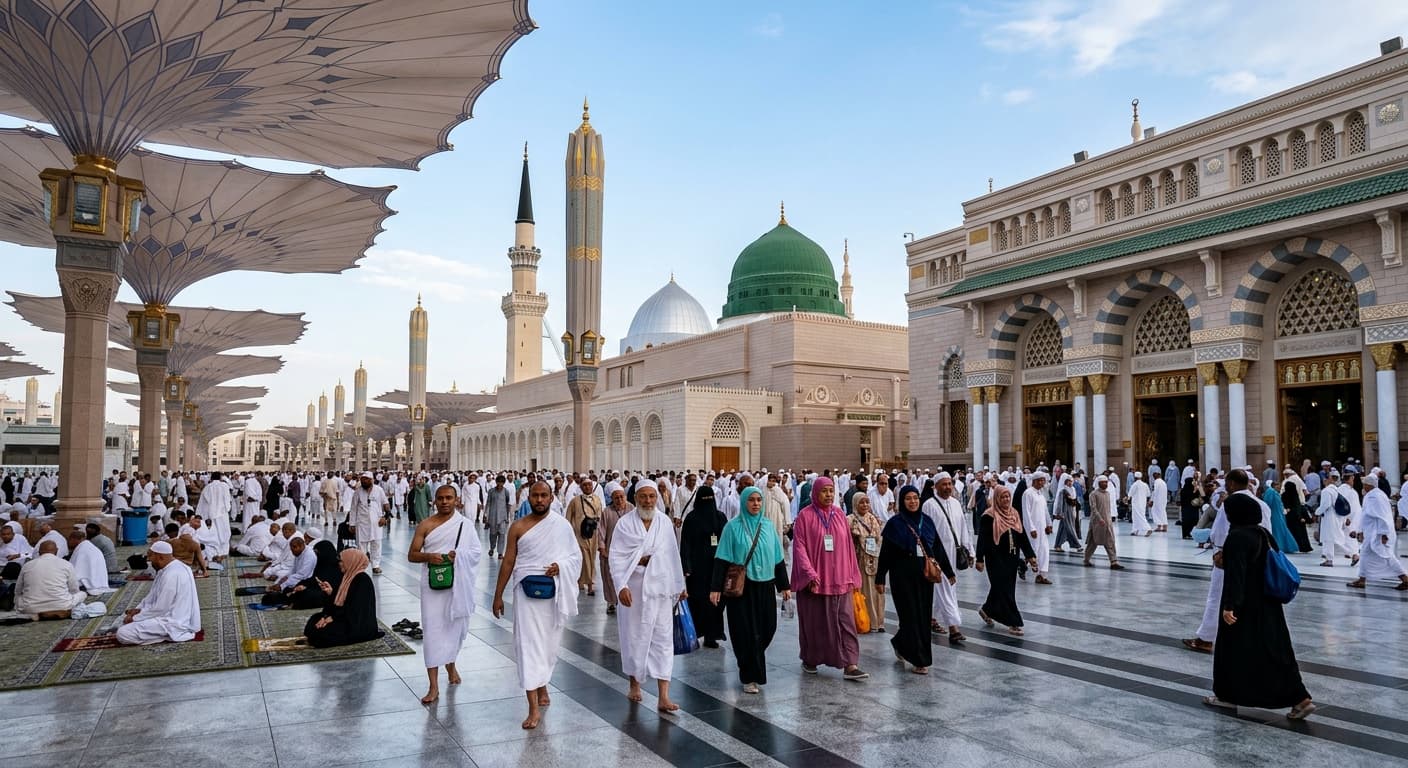
This is the Prophet's mosque, and it's the obvious starting point for any Madinah ziyarat. The building itself has been expanded dozens of times since the 7th century and now holds over a million worshippers during peak periods. The original structure from the Prophet's lifetime sits inside the current building, marked by the green dome visible from almost anywhere in the city.
Inside, the Rawdah is the section most pilgrims specifically want. It's the area between the Prophet's former home and his pulpit, and there's a tradition that this particular patch of ground is among the gardens of Paradise. Entry is managed through the Nusuk app now, with timed slots, because the space is small relative to demand. Book this before you arrive, not when you get there. Slots fill fast, especially during the weeks surrounding Hajj.
What the Rawdah visit actually looks like
You get a window, usually 30 to 45 minutes, and you're moved through in groups. It is not quiet or contemplative in the way photos suggest. It's crowded, the pace is managed by volunteers, and you'll likely spend more time walking toward it than inside it. Go anyway. Go with low expectations about the atmosphere and high expectations about what the visit means.
Quba Mosque, and why it's worth the trip across town
Quba Mosque is a short drive from Masjid Nabawi, maybe 15 to 20 minutes depending on traffic, and it holds a specific distinction: it's considered the first mosque built in Islam. There's a known practice of praying there on Fridays specifically, tied to a hadith about the reward of a visit equal to performing a smaller pilgrimage.
The building itself was renovated extensively in the 1980s and again more recently, so don't expect anything that looks ancient. What you're visiting is the site and the history attached to it, not an untouched structure. Fridays are packed. If you want to actually experience the place rather than shuffle through a crowd, go on a Tuesday or Wednesday morning instead.
Jannat ul Baqi: the cemetery most pilgrims walk past too fast
Jannat ul Baqi sits right next to Masjid Nabawi, which is partly why it gets underrated. It's the burial ground for a large number of the Prophet's companions and family members, and it's one of the oldest and most significant cemeteries in Islamic history.
Here's the part that surprises first-time visitors: there are no headstones, no markers, nothing elaborate. The graves are simple mounds of earth, deliberately unadorned. That plainness is the point, not an oversight. Gates open at specific times, generally after Fajr and sometimes after Asr, and the schedule shifts seasonally, so check locally rather than relying on a fixed time you read somewhere.
Women generally view Jannat ul Baqi from outside the boundary wall rather than entering, and that's still considered a complete visit.
Mount Uhud and the story behind it
Mount Uhud sits a few kilometers north of central Madinah and is tied to the Battle of Uhud in 625 CE, one of the defining early battles in Islamic history. At the base of the mountain is a cemetery holding the martyrs of that battle, including Hamza ibn Abdul-Muttalib.
This site works differently from the others on this list. There's no mosque to pray in, no queue, no app booking. You walk, you stand, and the value of the visit is almost entirely in knowing the history before you arrive. If you show up without context, it's just a hill. Read the background the night before, even fifteen minutes of it changes the visit completely.
The smaller sites people skip and shouldn't
Beyond the major four, there's a cluster of smaller Madinah historical places worth fitting in if your schedule allows a third or fourth day.
Masjid Qiblatain, the Mosque of the Two Qiblas, where the direction of prayer changed mid-prayer from Jerusalem to Makkah.
Masjid Ghamama, built near the spot associated with a prayer for rain during a drought.
The Seven Mosques (Sab'a Masajid), a cluster near the site of the Battle of the Trench, interesting for the history even though most of the structures are modern rebuilds.
None of these are essential. All of them add something if you have the time, and none require more than 20 minutes once you're there.
A rough itinerary if you only have three days
Day | Morning | Afternoon/Evening |
|---|---|---|
Day 1 | Masjid Nabawi, Rawdah slot if booked | Jannat ul Baqi after Asr |
Day 2 | Quba Mosque (avoid Friday) | Masjid Qiblatain, Masjid Ghamama |
Day 3 | Mount Uhud and martyrs' cemetery | Seven Mosques, free time at Masjid Nabawi |
Timing it around the actual Hajj calendar
If you're doing Madinah ziyarat before Hajj, build in a buffer. Flights get delayed, Nusuk slots don't always line up with your arrival date, and you don't want to be racing to Makkah with no margin before the 8th of Dhul Hijjah. Three to five days in Madinah, with one spare day built in, is realistic.
Doing it after Hajj tends to be easier logistically. You're not watching a calendar, the crowds in Madinah are often thinner once the main Hajj pilgrimage sites in Makkah have cleared out, and you can move at a slower pace. The trade-off is fatigue. Hajj is physically demanding, and a lot of pilgrims arrive in Madinah afterward wanting rest more than sightseeing. Plan accordingly rather than overbooking the days after Hajj ends.
One thing the standard advice gets wrong: it treats Madinah as optional padding around the "real" trip. For a lot of pilgrims, the quieter, less regimented days in Madinah end up mattering more than the intensity of Hajj itself. Nobody plans for that going in. It just happens once you're there.
Frequently asked questions
Is visiting Madinah part of Hajj or separate from it?
Visiting Madinah is not a pillar of Hajj and is not required for your pilgrimage to be valid. Most pilgrims still go, either before or after Hajj, because of the reward attached to praying in Masjid Nabawi and the proximity while already in Saudi Arabia.
How many days should I plan for Madinah ziyarat?
Three to five days is typical. Two full days covers Masjid Nabawi, Quba Mosque, and Jannat ul Baqi comfortably; a third day lets you add Mount Uhud and the smaller sites without rushing.
Can women visit Jannat ul Baqi and Mount Uhud?
Women can visit the Uhud site and the surrounding area without restriction. Jannat ul Baqi's gates are open to men only at fixed times; women typically view it from outside the boundary wall, which is still considered part of the ziyarat.
Do I need a separate permit for Madinah ziyarat sites?
No permit is needed for Quba Mosque, Jannat ul Baqi, or the Uhud site. Entry to the Rawdah inside Masjid Nabawi is managed through the Nusuk app, which requires a timed booking slot.
What is the best time of day to visit Quba Mosque?
Early morning, right after Fajr, has the shortest queues and the mildest weather. Friday is the busiest day because of the tradition of praying there specifically on Fridays, so avoid it if you want a quiet visit.