
Why is Hajj Farz on Muslims?
Hajj Farz gets reduced to 'if you can afford it' far too often. This post walks through what Istita'at actually means, where debt and mahram rules change the picture, and what Hajj-e-Badal is for.
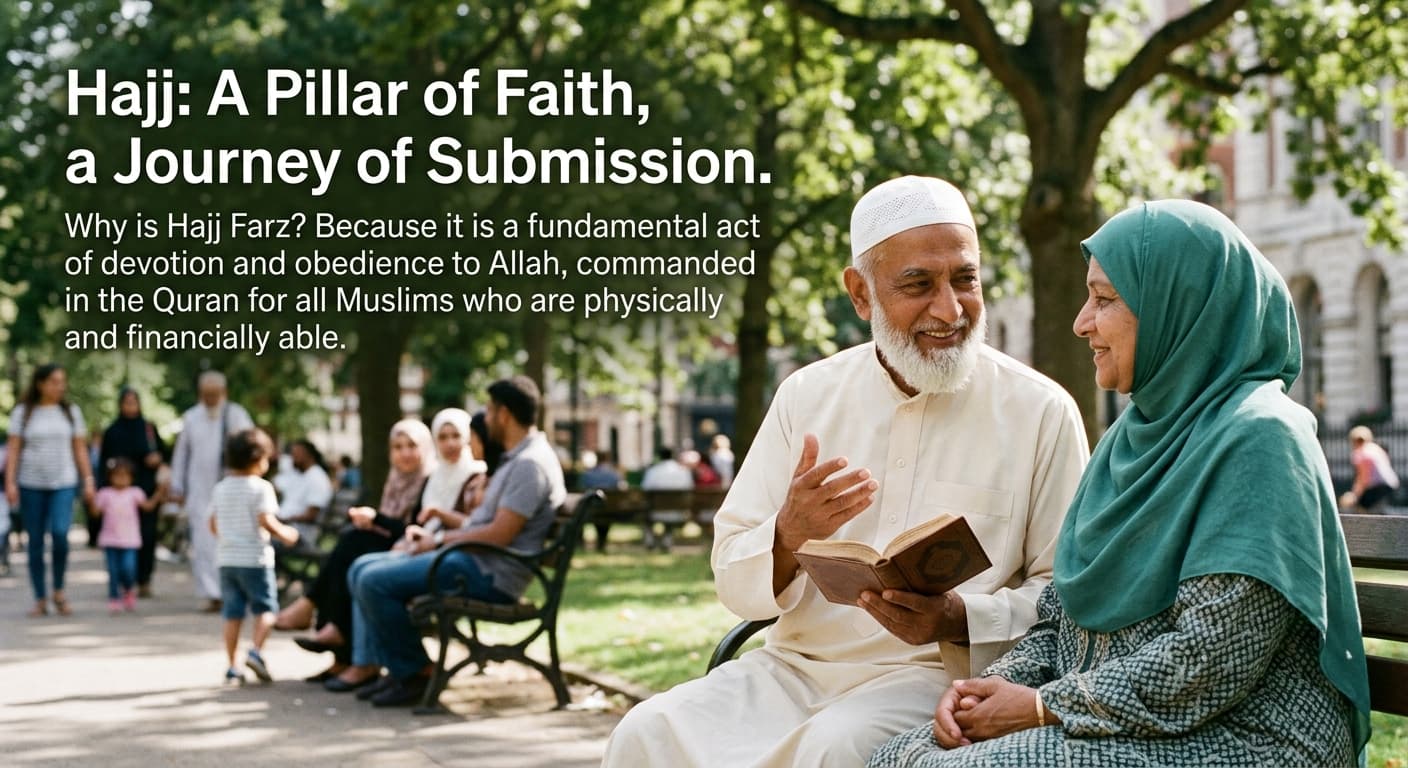
Why is Hajj Farz on Muslims?
Most people answer this question with one word: money. If you can afford the ticket, Hajj Farz applies to you, and if you can't, it doesn't. That's not wrong exactly, but it skips most of what actually makes Hajj Farz a serious legal obligation rather than a nice thing to do once in your life.
Hajj Farz on every adult Muslim comes from a direct Quranic command, not a scholarly recommendation layered on top of tradition. It sits alongside the Shahada, Salah, Zakat and Sawm as one of the five pillars of Islam, and it is the only one of the five that depends entirely on a person's circumstances rather than their will. You can pray five times a day regardless of your bank balance. You cannot stand at Arafah without a passport, a visa, savings, and a body capable of making the trip.
The verse that actually makes it obligatory
The core textual proof comes from Surah Al-Baqarah, verse 196, which instructs believers to complete Hajj and Umrah for the sake of Allah, as cited by Hijaz Hajj n Umrah. Surah Aal-e-Imran, verse 97, goes further and states plainly that Hajj is owed to Allah by anyone able to find a way there — the phrase used is often translated as "whoever is able to find a way."
That single condition, able to find a way, is the entire basis of Hajj Istita'at. Classical jurists spent centuries unpacking what "able" means in practice, because the Quran doesn't hand you a checklist. It gives you a principle and leaves the application to scholarship and circumstance.
When did Hajj become Farz in Islamic history?
Hajj became obligatory in the 9th year after Hijra, according to Alaf Travels. That's roughly seven years after the command to pray five times daily was established, and it places the obligation of Hajj among the later pillars to be formalised in Madinan Islam, once the Muslim community had the stability and numbers to make a yearly pilgrimage a realistic communal practice.
The timing matters more than it looks. Hajj requires Dhul Hijjah, the twelfth month of the Islamic calendar, and specifically the period between the 8th and 12th of that month, as noted by Islamic Relief UK. An obligation tied to a fixed five-day window, in a specific city, during a specific month, could not reasonably have been imposed while Muslims were scattered, persecuted, or without safe passage to Makkah. It became Farz once it became achievable.
Who is Hajj Farz actually upon?
Here's where the common advice gets lazy. "If you can afford it" is true but incomplete. Islamic jurisprudence lays out a fuller set of conditions, and all of them need to hold at once, not just the financial one.
You must be Muslim, adult (past puberty), and of sound mind — children and those without mental capacity are exempt entirely, not just delayed.
You must be physically capable of the journey and the rites themselves, which include walking several kilometres a day across multiple sites over five days.
You must have enough wealth to cover travel, accommodation and the cost of living for dependents left behind, without borrowing to do it.
For women, a mahram or an equivalent safe travel arrangement recognised by their school of thought must be in place.
Miss any one of those and Hajj Farz does not apply to you yet. It doesn't vanish — it's deferred until the condition is met, which is why someone who becomes wealthy at 55 after decades of poverty is still obligated, Farz having simply been waiting on them the whole time.
Fard, Wajib, and where people get confused
Within the pilgrimage itself, not every rite carries the same weight, and conflating them is where a lot of confusion about "is Hajj Farz" complaints actually comes from.
Category | Example rite | If missed |
|---|---|---|
Fard | Standing at Arafah (Wuquf) | Hajj is invalid, must be repeated |
Wajib | Overnight stay at Muzdalifah | Hajj stands, but a penalty (dam) is due |
Sunnah | Entering Makkah through a specific gate | No penalty, reward is simply missed |
Hajj Farz, at the level of the whole pilgrimage, is a different question from fard within the pilgrimage — one is about who has to go, the other is about what you do once you're there.
Does debt cancel the obligation?
This is the part most guides wave past with a single sentence, and it's one of the most practically relevant questions a reader actually has. Debt does not automatically remove Hajj Farz. A mortgage, a car loan, a student loan being repaid on schedule — none of these typically block the obligation, because they're structured, ongoing commitments rather than money owed right now to a specific creditor. What does block it is overdue, demandable debt. If a person owes someone a sum that could be called in and they have no reasonable prospect of repaying it alongside funding Hajj, most scholars treat that as a failure of Istita'at. The order of priority is simple: debts to people come before a voluntary-timing obligation to Allah, because Hajj Farz is owed once in a lifetime and a debt is owed now.
Worked case: someone has 6,000 dollars saved, a Hajj package costs 5,500, and they have a 2,000 dollar credit card balance overdue by three months. They are not considered financially able yet. Compare that to someone with the same savings and the same package cost, but a car loan with 400 dollars due monthly and no missed payments — most jurists would say Hajj Farz still applies to them, because that debt is current and structured, not a crisis sitting on top of the trip.
Mahram rules and modern travel — where the old guidance strains
Classical rulings require a woman to travel with a mahram, a close male relative she cannot marry, for Hajj. That rule was built for a world of caravans and months-long overland journeys through open desert. A six-hour flight on a chaperoned, government-vetted Hajj group with hundreds of other women is a genuinely different risk profile, and several contemporary scholars, including bodies within the Hanafi and Maliki traditions operating in Western countries, have issued allowances for women to travel in a trusted group of women without a mahram when the route and accommodation are secure. This is not settled across the board. Saudi Arabia itself changed its entry rules in 2021 to permit women over 45 to perform Hajj without a mahram if travelling within an organised group, which is a civil policy shift rather than a jurisprudential one, but it has pushed the fiqh conversation along. If you're advising someone on this, the honest answer is that the ruling depends heavily on which scholar and which country's Hajj authority they're working under — there isn't one universal answer here, and pretending otherwise does the reader a disservice.
What if the person who owes Hajj has already died, or can't travel?
This is Hajj-e-Badal, and it's one of the more practically useful corners of this topic that gets almost no real estate on most pages. If someone had the means and the obligation fell due on them, but they died before performing it, their estate is expected to fund someone else to perform Hajj on their behalf, drawn from the deceased's wealth before inheritance is distributed. The same applies to someone permanently unable to travel — advanced age, a degenerative illness, a disability that makes the physical rites impossible and isn't expected to improve. The person performing Hajj-e-Badal must have already completed their own obligatory Hajj first; you cannot discharge someone else's Farz before you've discharged your own.
A detail that trips people up: Hajj-e-Badal isn't available for someone who is simply delaying out of laziness or bad planning while still capable. It's specifically for death or genuine, lasting incapacity. If the person could still go next year, the obligation stays theirs.
What happens if you just skip it
There's no earthly punishment mechanism built into the religion for this the way there is for, say, an unpaid civil debt. But the scholarly consensus treats deliberately delaying Hajj Farz once Istita'at is met, with no valid excuse, as a serious sin — some early scholars went as far as questioning the faith of someone who had full capability for decades and simply never went. The obligation doesn't expire. It sits there, due, for as long as the person is alive and able. Which raises a question most of the ranking advice doesn't touch: what counts as "deciding not to go" versus "still planning to go eventually"? Islamic law doesn't put a hard deadline on it beyond "as soon as able," and that ambiguity is arguably the most uncomfortable honest thing about this whole obligation.
Frequently asked questions
When did Hajj become Farz in Islam?
Hajj became obligatory in the 9th year after Hijra. It followed earlier pillars like Salah, once the Muslim community in Madinah had the stability for a yearly pilgrimage to become realistic.
Who is Hajj Farz upon according to Islamic jurisprudence?
It applies to every sane, adult Muslim who is physically capable of the journey and financially able to cover it, including dependents' needs, without borrowing. It becomes due once, not annually, and stays due until the person meets these conditions.
Is Hajj Farz if a person has outstanding debts or loans?
Structured, current debts like a mortgage or car loan generally don't cancel the obligation as long as payments are up to date. Overdue debt owed directly to a creditor, with no realistic plan to repay it, is treated as a failure of Istita'at and takes priority over going.
What is the difference between Fard and Wajib in Hajj?
Fard rites, like standing at Arafah, are drawn from clear textual proof and missing one invalidates the entire Hajj. Wajib rites, like the night at Muzdalifah, are required too, but missing one is corrected with a penalty rather than voiding the pilgrimage.
Can Hajj be performed on behalf of someone else who passed away?
Yes, through Hajj-e-Badal. A person who already completed their own obligatory Hajj can perform it on behalf of someone who died owing the obligation, or who is permanently unable to travel due to illness, age, or disability.